

 ','..','$myPermit') ?>
SYLLABUS Previous: 5.2.1 Vanilla swaps
Up: 5.2 Credit derivatives
Next: 5.3 Methods for bonds
','..','$myPermit') ?>
SYLLABUS Previous: 5.2.1 Vanilla swaps
Up: 5.2 Credit derivatives
Next: 5.3 Methods for bonds
The cap-floor parity relation (2.2.4#eq.3) shows that both
share many features with swaps. The contract is again decomposed into
elementary intervals and the valuation of every caplet or floorlets
is carried out backwards starting from zero, since a finite time has
to pass to accumulate interest rate earnings.
The incremental change reflects the difference between the spot and the
cap-/floor rates; contrary to swaps, this difference can never become
negative, since caps and floors do not carry any obligation.
Using the Vasicek model, the contract can therefore be viewed as a bond
paying a continuously compounded annual coupon of
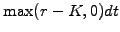 for
caplets and
for
caplets and
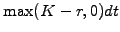 for floorlets. By analogy with the swap
rate, define the
for floorlets. By analogy with the swap
rate, define the
 or
or StrikePrice),
expressed as the relative annual return above /below which the
contract pays the rate difference, e.g. 0.04 for a cap rate of 4%.
The VMARKET applet below calculates the value of a caplet with a cap rate of 8%, as a function of the spot rate and an increasing time to the maturity.
The same models used to forecast drifts in the interest rate can also be used here, but the volatility should be modified to reflect the uncertainty in the interest earnings (exercise 5.07).
SYLLABUS Previous: 5.2.1 Vanilla swaps Up: 5.2 Credit derivatives Next: 5.3 Methods for bonds