','..','$myPermit') ?>
SYLLABUS Previous: 3.3.1 Wiener process and
Up: 3.3 Improved model using
Next: 3.3.3 Evaluate an expectancy
','..','$myPermit') ?>
SYLLABUS Previous: 3.3.1 Wiener process and
Up: 3.3 Improved model using
Next: 3.3.3 Evaluate an expectancy

Despite the short-hand differential notation that has been used so far,
the stochastic differential equation (3.3.1#eq.1) is formally defined
only in its integral form: in other words, a probability weighted
average has to be carried out before the random sampling from the Wiener
process acquires any significance.
The stochastic or Itô calculus dealing properly with the extensions of
the usual Riemann integrals to non-smooth differentials  leads to
the Itô lemma and draws on mathematics that goes beyond the scope of
this course.
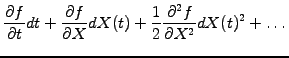
The same result can however be derived from a Taylor expansion in multiple
dimensions, keeping terms up to
leads to
the Itô lemma and draws on mathematics that goes beyond the scope of
this course.
The same result can however be derived from a Taylor expansion in multiple
dimensions, keeping terms up to
 and
and
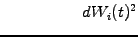
 and applying the special rules for stochastic calculus:

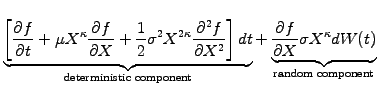
 , and a random component
proportional to the Wiener increment
.
Remember that the factor
, and a random component
proportional to the Wiener increment
.
Remember that the factor  = 0 or 1 here chooses between a normal
or log-normal distribution of the price increments
= 0 or 1 here chooses between a normal
or log-normal distribution of the price increments  and can also take
other values if this is found to be appropriate.
and can also take
other values if this is found to be appropriate.
SYLLABUS Previous: 3.3.1 Wiener process and Up: 3.3 Improved model using Next: 3.3.3 Evaluate an expectancy






![$\displaystyle \frac{\partial f}{\partial t} dt
+ \frac{\partial f}{\partial X} ...
...ac{1}{2} \frac{\partial^2 f}{\partial X^2} X^{2\kappa} [\mu dt +\sigma dW(t)]^2$](s3img105.gif)