','..','$myPermit') ?>
SYLLABUS Previous: 4.5 Methods for European
Up: 4.5 Methods for European
Next: 4.5.2 Expected value of
','..','$myPermit') ?>
SYLLABUS Previous: 4.5 Methods for European
Up: 4.5 Methods for European
Next: 4.5.2 Expected value of

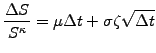
 , using a finite number of steps in time
 , which result in correspondingly small increments in the
price
, which result in correspondingly small increments in the
price 
 are the drift and the volatility measured
from the market,
are the drift and the volatility measured
from the market,
 is a normally distributed
random number generated anew for each step and the parameter
is a normally distributed
random number generated anew for each step and the parameter  is chosen to reproduce a normal walk with
  or a log-normal
walk with
or a log-normal
walk with  .
.
k=0,...,numberOfRealisations-1) samples modeling
each one possible evolution of the asset (currentState[k][0]) and
an equal number of markers (mark[k][0]) to account for barriers
in exotic options, the
initialization in SamplingSolution.java
has been implemented as
    numberOfRealisations = runData.getParamValueInt("Walkers");
    strike  = runData.getParamValue("StrikePrice");
    kappa   = runData.getParamValue("LogNkappa");
                                                                    //Separable
    if( (Math.abs(kappa)<0.001) ||(Math.abs(kappa-1.)<0.001)){
      currentState = new double[numberOfRealisations][1];
      for (k=0; k<numberOfRealisations; k++) currentState[k][0]=strike;
                                                                    //Barriers
      if(scheme.equals(vmarket.MCIN)||scheme.equals(vmarket.MCINPP)){
        mark = new double[numberOfRealisations][1];
        for (k=0; k<numberOfRealisations; k++) mark[k][0]=0.;
      } else if (scheme.equals(vmarket.MCOUT)||scheme.equals(vmarket.MCOUTPP)){
        mark = new double[numberOfRealisations][1];
        for (k=0; k<numberOfRealisations; k++) mark[k][0]=1.; }
If the parameter kappa is sufficiently close to log-/normal with
 0 or 1, the first four lines initialize the array
currentState[k][0] with numberOfRealisations samples of
one single price stored in a one dimensional array with an idle index
[0]; the entire array is (arbitrarily or, rather, for plotting)
initialized with the strike price currentState[k][0]=strike.
The value of the selector scheme decides if the modeling of
an in-/out-barrier option with-/out particle plotting requires the
creation of an additional marker array mark[k][0], which has
to be initialized with the corresponding behavior.
Not shown in the code above but visible in the
VMARKET listing, is that a parameter kappa sufficiently different from zero
or one can be used to initialize a two dimensional array
currentState[k][j] with j=0,..., mesh.size()-1
different prices; these are evolved in parallel if the problem is
not separable-e.g. when the increments depend in a non-trivial
manner on the asset price.
), new values for currentState[k][0] are
calculated in MCSSolution.java
repeating for each step
    double timeStep = runData.getParamValue("TimeStep");
    double strike   = runData.getParamValue("StrikePrice");
    double mu       = runData.getParamValue("Drift");
    double divid    = runData.getParamValue("Dividend");
    double sigma    = runData.getParamValue("Volatility");
    double barrier  = runData.getParamValue("Barrier");

    if(Math.abs(kappa-1.)<0.001){               //Separable log-normal
      for(int k=0; k<numberOfRealisations; k++)
        currentState[k][0]+= currentState[k][0]*( (mu-divid)*timeStep +
                random.nextGaussian()*sigma*Math.sqrt(timeStep) );

                                                       //Barriers
      if (scheme.equals(vmarket.MCOUT) || scheme.equals(vmarket.MCOUTPP)){
        for(int k=0; k<numberOfRealisations; k++)
          if ((barrier >= 0. && currentState[k][0]-strike > strike*barrier)||
              (barrier <  0. && currentState[k][0]-strike < strike*barrier)  )
            mark[k][0]=0.;
      } else if (scheme.equals(vmarket.MCIN) || scheme.equals(vmarket.MCINPP)){
        for(int k=0; k<numberOfRealisations; k++)
          if ((barrier >= 0. && currentState[k][0]-strike > strike*barrier)||
              (barrier <  0. && currentState[k][0]-strike < strike*barrier)  )
            mark[k][0]=1.;
      }
    }
The first four lines compute the deterministic (mu-divid)*timeStep and
the random component random.nextGaussian()*sigma*Math.sqrt(timeStep)
of the evolution, which are easily identified as the right-hand side of
(4.5.1#eq.1).
Further scaling by the underlying asset price currentState[k][0]
reproduces the log-normal distribution of the increments, which are finally
accumulated with the Java operator currentState[k][0]+=increment.
The variable mark[k][0] is reset to zero (alt. one) whenever the
condition for an ``out-'' (alt. ``in-'') barrier is met for a given sample.
Note that the position of the barrier is here defined relative to the
initial condition, using a positive (alt. negative) value of the variable
barrier to distinguish a barrier above (alt. below) the initial
price of the underlying.
This relative definition is here required to keep the problem separable, so
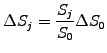
that the evolution of any price  can be obtained from the same sequence
of increments
can be obtained from the same sequence
of increments
 normalized to
  using the scaling
 or
or
 exceed unity in
a log-normal walk.
For the record, note that the stochastic differential (assuming
exceed unity in
a log-normal walk.
For the record, note that the stochastic differential (assuming
 ) is not an exact model neither, since a finite
number of trades sets a lower limit on the duration between trades on
the markets.
The VMARKET applet below illustrates some
effects of the time discretization for the case of an down-and-in barrier
put option.
) is not an exact model neither, since a finite
number of trades sets a lower limit on the duration between trades on
the markets.
The VMARKET applet below illustrates some
effects of the time discretization for the case of an down-and-in barrier
put option.
SYLLABUS Previous: 4.5 Methods for European Up: 4.5 Methods for European Next: 4.5.2 Expected value of