','..','$myPermit') ?>
SYLLABUS Previous: 1.2.4 Characteristics and dispersion
Up: 1.2 Differential Equations
Next: 1.3 Prototype problems
','..','$myPermit') ?>
SYLLABUS Previous: 1.2.4 Characteristics and dispersion
Up: 1.2 Differential Equations
Next: 1.3 Prototype problems
Differential calculus is at the heart of science and engineering because
it describes interactions locally, relating infinitesimal changes at the
microscopic scale to the macroscopic behavior a system.
At the macroscopic scale, global quantities can be found that remain
constant in spite of the microscopic changes: the total density, the
momentum and the energy inside a closed box that is isolated from the
outside world do not change.
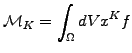
Conservation laws can in general be constructed by taking moments
in phase space  , where the moment of order
  a function
  is
defined by the integral
is
defined by the integral
 refers to the total density,
 the total momentum and
 the total energy in the system.
Conservation laws provide useful self-consistency checks when PDEs are
solved in an approximate manner with the computer: deviations from the
initial value are a clear signal for the loss of accuracy in a numerical
solution that evolves in time.
the total energy in the system.
Conservation laws provide useful self-consistency checks when PDEs are
solved in an approximate manner with the computer: deviations from the
initial value are a clear signal for the loss of accuracy in a numerical
solution that evolves in time.
SYLLABUS Previous: 1.2.4 Characteristics and dispersion Up: 1.2 Differential Equations Next: 1.3 Prototype problems