','..','$myPermit') ?>
SYLLABUS Previous: 1.4 Numerical discretization
Up: 1.4 Numerical discretization
Next: 1.4.2 Sampling on a
','..','$myPermit') ?>
SYLLABUS Previous: 1.4 Numerical discretization
Up: 1.4 Numerical discretization
Next: 1.4.2 Sampling on a
One of the most important properties of a numerical approximation based on a finite number of data points is that the approximation converges to the exact value as more information is gathered (exercise 1.01). This convergence can be defined locally for any arbitrary point in space and time (more restrictive) or by monitoring a global quantity (more permissive).
The convergence rate can be estimated experimentally from a geometric
sequence of approximations
 , by successively refining the
numerical resolution
, by successively refining the
numerical resolution
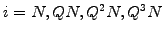 , for example by doubling the
resolution a couple of times when
, for example by doubling the
resolution a couple of times when 
![$\displaystyle r=\frac{\ln\left[(f^{(N)}-f^{(QN)})/(f^{(QN)}-f^{(Q^2N)})\right]} {\ln[Q]}$](s1img132.gif) |
(1.4.1#eq.1) |
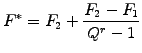
 , it is possible to further improve
the accuracy of the numerical approximation by using a so-called
Richardson extrapolation
, it is possible to further improve
the accuracy of the numerical approximation by using a so-called
Richardson extrapolation
 is obtained from an evaluation
 and its refinement
  .
.
Let's take an example and approximate the function
 on a
grid in
on a
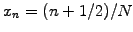
grid in ![$ [0;1]$](s1img139.gif) , simply by sampling the value of the function in the
middle of
, simply by sampling the value of the function in the
middle of  intervals at
 .
The approximation for the value at the origin
.
The approximation for the value at the origin
 converges to zero provided that
 , which is best visualized in a convergence study using
a lin-lin plot (figure 1.4.1#fig.1, left).
, which is best visualized in a convergence study using
a lin-lin plot (figure 1.4.1#fig.1, left).
![\includegraphics[height=5.7cm]{figs/convlin2.eps}](s1img143.gif)
![\includegraphics[height=5.7cm]{figs/convlog2.eps}](s1img144.gif)
|
![$ r=\ln\left[( (2N)^{-\alpha} - (4N)^{-\alpha})/
( (4N)^{-\alpha} - (8N)^{-\alpha})\right]/\ln[2]
= \alpha$](s1img145.gif) drops as
drops as
 as shown by the lower slope in the
log-log plot (figure 1.4.1#fig.1, right).
Not apparent in the log-log plot is that the approximation
converges to a different value
as shown by the lower slope in the
log-log plot (figure 1.4.1#fig.1, right).
Not apparent in the log-log plot is that the approximation
converges to a different value
 when
when  .
.
The mid-point rule (sect.3.3) can be used to approximate an
integral by computing the area of small boxes in order to evaluate the
global quantity
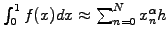 with
with  . Global convergence is achieved for
  ;
because of the weak singularity, the convergence rate drops from the
;
because of the weak singularity, the convergence rate drops from the
 expected from a quadrature of smooth
functions to
expected from a quadrature of smooth
functions to
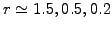 when
when
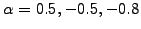 .
.
SYLLABUS Previous: 1.4 Numerical discretization Up: 1.4 Numerical discretization Next: 1.4.2 Sampling on a