The inhomogeneous mesh is constructed from a grid density function fg(x), that is the sum of a number N Lorentzian functions

and a constant function. The integral of fg(x)

is the relative number of gridpoints xi, such that x>xi.
The inhomogeneous mesh is constructed from a grid density function
fg(x), that is the sum of a number N Lorentzian functions
and a constant function. The integral of fg(x)
is the relative number of gridpoints xi, such that x>xi.
This has been inplemented into mesh.java
( see the functions gridfunction and Mesh ).
The linear system is
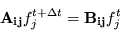
The matrix coefficients in Latex notation
A_{ij} = \int_{0}^{x_{max}} dx [ e_i (x) e_j(x) + ( u(x) e_i (x) e'_j(x) + D(x) e'_i (x) e'_j(x) ) \theta \Delta t]
B_{ij} = \int_{0}^{x_{max}} dx [ e_i (x) e_j(x) - ( u(x) e_i (x) e'_j(x) + D(x) e'_i (x) e'_j(x) ) \theta \Delta t]
where $ \theta \in [ 0.5 , 1 ] $ is a numerical parameter (describing
the expliciteness), $ u , D $ is the velocity and the diffusion coefficient
and $ e' =de/dx $. The integrals are evaluated using a 2-point Gaussian
quadrature (see
lecture notes). This has been inplemented into FEMSolution.java
149-220 .
Before investigating a problem with an inhomogeneous mesh it was confirmed the new implementation of the numerics gave the same result as the original implementation.
Please run (use the "FEM / Tunable Integration")