

 ','..','$myPermit') ?>
SYLLABUS Previous: 5.3 Particle orbits
Up: 5 MONTE-CARLO METHOD
Next: 5.5 When should you
','..','$myPermit') ?>
SYLLABUS Previous: 5.3 Particle orbits
Up: 5 MONTE-CARLO METHOD
Next: 5.5 When should you
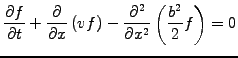
Let us use now the Feynman-Kac theorem and evolve a large number of stochastic particle orbits to approximate the advection diffusion equation
 |
(1) |
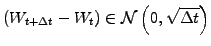 ,
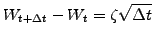
the Wiener process can be written explicitly
,
the Wiener process can be written explicitly
 |
(3) |
 are normally distributed random numbers.
The central limit theorem states that any large sum involving
are normally distributed random numbers.
The central limit theorem states that any large sum involving  random
numbers equally distributed with zero mean and unit variance will eventually
converge to
random
numbers equally distributed with zero mean and unit variance will eventually
converge to
 .
Any such random number could therefore be used for
.
Any such random number could therefore be used for  provided that
the number of time steps used to approximate the differential is large enough;
choosing
however leads to the fastest convergence.
provided that
the number of time steps used to approximate the differential is large enough;
choosing
however leads to the fastest convergence.
A numerical Monte Carlo scheme for the advection-diffusion equation is now
constructed, using  particles to sample the possible outcomes of the
entire ensemble of orbits
particles to sample the possible outcomes of the
entire ensemble of orbits
 |
(4) |
      for(int j = 0; j < numberOfParticles; j++){
        particlePosition[j] += velocity * timeStep +
          random.nextGaussian() *
          Math.sqrt(2 * diffusCo * timeStep);
        // Insert here your periodic boundary conditions (exercise 5.03)
      }
and can be tested in the JBONE applet below
JAVA is one of the few programming languages that has a normal
pseudo random numbers generator
 .
Other programming languages generally provide only uniform pseudo random
numbers
.
Other programming languages generally provide only uniform pseudo random
numbers
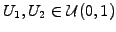
 and the Box Müller method can then be
used to transfrom them into
with the algorithm:
and the Box Müller method can then be
used to transfrom them into
with the algorithm:
 .
.
 |
.
x+=dx as being equivalent to
x=x+dx.
SYLLABUS Previous: 5.3 Particle orbits Up: 5 MONTE-CARLO METHOD Next: 5.5 When should you
