
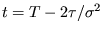





The transform equation has been solved with an implicit
finite elements scheme with roof function and the integration is performe
with a mid point approximation, which is quite successful for such diffusion
equations. The results are running in the following applet.
Comparison with resolution using a Monte
Carlo method is available on this link.
The resulting code, implemented in jbone is given below :
//=======================================================================
// FEM - Black Scholes equation
//=======================================================================
BandMatrix a = new BandMatrix(3, f.length);
BandMatrix b = new BandMatrix(3, f.length);
double[] c = new double[f.length];
double step=jbone.step;
double sigma = 0.45;
double Dzero = 0.;
double Te = 0.25;
double re = 0.1;
double Eu = 10.0;
double kone = 2*re/(sigma*sigma);
double ktwo = 2*(re-Dzero)/(sigma*sigma);
double tempsAv=timeStep*(double)(step);
double tauAv=(tempsAv)/2*sigma*sigma;
double ix=0.;
double[] dix = new double[f.length];
double dtau=(timeStep)/2*sigma*sigma;
// New coordinate frame
for (int i=1;i<=n; i++) {
dix[i]=(Math.log(dx[0]*(double)(i+1.)/Eu))-(Math.log(dx[0]*(double)(i)/Eu));
}
dix[0]=(Math.log(dx[0]/Eu))+10.;
//Resolution of the diffusion equation
for (int i=1; i<n; i++) {
a.setR(i,
dix[i]/4. -dtau/dix[i]* theta );
a.setD(i,1./4.*(dix[i]+dix[i-1])+(1./dix[i-1]+1./dix[i])*dtau*
theta );
a.setL(i,
dix[i-1]/4. -dtau/dix[i-1]* theta );
b.setR(i,
dix[i]/4. -dtau/dix[i]*(theta-1) );
b.setD(i,1./4.*(dix[i]+dix[i-1])+(1./dix[i-1]+1./dix[i])*dtau*(theta-1)
);
b.setL(i,
dix[i-1]/4. -dtau/dix[i-1]*(theta-1) );
}
//boundary conditions
a.setR(0, 0. );
//Matrix elements
a.setD(0, 1. );
a.setL(0, 0. );
b.setL(0, 0. );
//Right hand side
b.setD(0, 0. );
b.setR(0, 0. );
a.setD(n, 1. );
a.setL(n, 0. );
b.setL(n, 0. );
//Right hand side
b.setD(n, 0. );
b.setR(n, 0. );
c=b.dot(g);
//Right hand side
c[0]=0.;
c[n]=5.75/(Eu*Math.exp(-0.5*(ktwo-1.)*0.47-(.25*(ktwo-1.)*(ktwo-1.)*0.47+kone)*tauAv));
gp=a.solve3(c);
//conversion of u -> V (from Xspace to
Sspace)
for (int i=1; i<=n; i++) {
ix=Math.log((double)(i)*dx[0]/Eu);
fp[i]=gp[i]*(Eu*
Math.exp(-0.5*(ktwo-1.)*ix-(.25*(ktwo-1.)*(ktwo-1.)*ix+kone)*tauAv));
}
fp[0]=0.;
isDefined = true;