

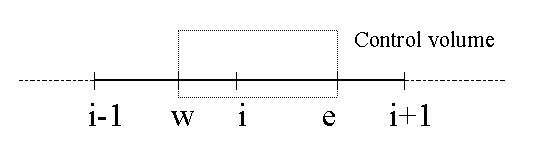

For an implicit approach, V will equal Vt+Dt.
The evaluation of the quantities at e and w depends on the scheme. The
one choosen for this application in Upwind. For any quantity f,
regarding the sign of the tern before the first derivative, we have :
fe=fi+1 and fw=fi.
the derivative term is calculated from a first order Taylor expansion
serie. Further information could be found in Patankar S. V. 1980. Numerical
heat transfer and fluid flow. (Eds. Taylor and Francis)
You can try to run it in the applet below.
Comparison with resolution using a Monte Carlo method is available on this link.
The resulting code, implemented in jbone is given below :
//=======================================================================
// FV Black-Scholes equation
//=======================================================================
BandMatrix a = new BandMatrix(3, f.length);
BandMatrix b = new BandMatrix(3, f.length);
double[] c = new double[f.length];
double[] cst = new double[f.length];
double step=jbone.step;
double sigma = 0.45;
double Dzero = velocity;
double re = 0.1;
double h=dx[0];
double alphabs=re-Dzero-2*sigma*sigma;
double betabs =2*re-sigma*sigma-Dzero;
double moinsdt = timeStep;
for (int i=1; i<=n-1; i++) {
a.setR(i, -(double)(i+1)*(double)(i+1)*sigma*sigma/2*moinsdt- alphabs*(double)(i+1)*moinsdt);
a.setD(i, 1. +sigma*sigma*moinsdt*(double)(i)*(double)(i) +(double)(i)*moinsdt*alphabs-
betabs*moinsdt );
a.setL(i, -(double)(i-1)*(double)(i-1)*sigma*sigma/2*moinsdt);
b.setL(i, 0.0 ); //Right hand side
b.setD(i, 1. ); b.setR(i, 0.0 ); } //Matrix elements
// Definition of the boundary conditions
a.setR(0, 0. ); //Matrix elements
a.setD(0, 1. );
a.setL(0, 0. );
b.setL(0, 0. ); //Right hand side
b.setD(0, 0. );
b.setR(0, 0. );
b.setL(n, 0. ); //Right hand side
b.setD(n, 1. );
b.setR(n, 0. );
a.setD(n, 0. );
a.setL(n, 1. );
c=b.dot(f); //Right hand side
c[n]=5.75;
fp=a.solve3(c);
isDefined = true;