

 ','..','$myPermit') ?>
SYLLABUS Previous: 1.3 The risk and
Up: 1 INTRODUCTION
Next: 1.5 Historical data and
','..','$myPermit') ?>
SYLLABUS Previous: 1.3 The risk and
Up: 1 INTRODUCTION
Next: 1.5 Historical data and

 at a constant expected return
  provided that the prices are
partly de-correlated. By varying the proportions invested in each asset,
an efficient frontier
can be calculated where the highest return is expected for a given
volatility (continuous line in blue).
provided that the prices are
partly de-correlated. By varying the proportions invested in each asset,
an efficient frontier
can be calculated where the highest return is expected for a given
volatility (continuous line in blue).
![\includegraphics[width=7cm]{figs/MPTFrontier2.eps}](s1img62.gif)
|
 and partly
in assets located on the efficient frontier (1.4#fig.1). He found
that the ``best'' portfolios, located on the broken line in red, intersect
the efficient frontier where the highest return
and partly
in assets located on the efficient frontier (1.4#fig.1). He found
that the ``best'' portfolios, located on the broken line in red, intersect
the efficient frontier where the highest return  is achieved if the
money has to be borrowed on the market. This led him to the definition of
what is now known as the Sharpe ratio,
where the reward-to-risk from a portfolio
is achieved if the
money has to be borrowed on the market. This led him to the definition of
what is now known as the Sharpe ratio,
where the reward-to-risk from a portfolio  is measured as the excess
return over the risk free rate divided by the total volatility
is measured as the excess
return over the risk free rate divided by the total volatility
 with
the average performance from a market index
with
the average performance from a market index
 over
different periods of time, Sharpe later developed the
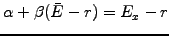
capital asset pricing model (CAPM)
over
different periods of time, Sharpe later developed the
capital asset pricing model (CAPM)
 relative performance from taking risks) and the offset alpha
(
relative performance from taking risks) and the offset alpha
( relative performance from arbitrage and costs).
To ``beat the market'' alpha should always be positive and beta larger
than unity. Unfortunately for most of the investors, commercial funds
generally have a negative alpha because of the 1-2% management costs
that are payed in the form of commissions.
Some say that expertise justifies the costs because of additional earnings
made from arbitrage: this is in general not true, because arbitrage is a
zero-sum game,
so that whatever makes one manager look better only make another look worse!
The value added by the fund manager therefore resides mainly in beta, i.e.
in the management of risk.
relative performance from arbitrage and costs).
To ``beat the market'' alpha should always be positive and beta larger
than unity. Unfortunately for most of the investors, commercial funds
generally have a negative alpha because of the 1-2% management costs
that are payed in the form of commissions.
Some say that expertise justifies the costs because of additional earnings
made from arbitrage: this is in general not true, because arbitrage is a
zero-sum game,
so that whatever makes one manager look better only make another look worse!
The value added by the fund manager therefore resides mainly in beta, i.e.
in the management of risk.
 is the mean,
  the variance and
  the standard
deviation. Higher order central moments are defined from
the standard
deviation. Higher order central moments are defined from
![$ \mu_k=E[(X-\mu)^k]$](s1img82.gif) , such as the skewness
, such as the skewness
 and the curtosis
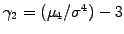 .
Under general conditions, the sum of a large number of random variables
is approximatively normally distributed
.
Under general conditions, the sum of a large number of random variables
is approximatively normally distributed
![$ f\approx \mathcal{N}[\mu,\sigma^2]$](s1img85.gif)
 .
Unbiased estimates for the mean and variance of
.
Unbiased estimates for the mean and variance of  data points
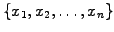 generated by a normally distributed process
can be calculated from
generated by a normally distributed process
can be calculated from
 is obtained by solving the system of normal equations
SYLLABUS Previous: 1.3 The risk and Up: 1 INTRODUCTION Next: 1.5 Historical data and
 from a mix of two volatile assets
 and
and
 that are partly correlated. The plot shows how, for the
same expected return
that are partly correlated. The plot shows how, for the
same expected return  , the combined risk from two assets is lower
than the average that is calculated when the risks of the assets are
evaluated separately
, the combined risk from two assets is lower
than the average that is calculated when the risks of the assets are
evaluated separately
 .
The tangent (broken line in red) drawn from the risk-free rate
.
The tangent (broken line in red) drawn from the risk-free rate  intersects the efficient frontier (line in blue) at
 where the best portfolio is located.

![$\displaystyle \mathrm{Corr}[X,Z]= \frac{\mathrm{Cov}[X,Z]}{\sqrt{\mathrm{Var}[X]\mathrm{Var}[Z]}} \hspace{1cm} \in[-1; 1]$](s1img72.gif)
![$\displaystyle \mathrm{Cov}[X,Z]$](s1img73.gif)
![$\displaystyle = E[XZ]-E[X]E[Z]
= E[(X-\mu_x)(Z-\mu_z)]$](s1img74.gif)
![$\displaystyle \mathrm{Var}[X]$](s1img75.gif)
![$\displaystyle = E[X^2]-(E[X])^2
= E[(X-\mu)^2]\equiv \sigma^2$](s1img76.gif)
![$\displaystyle E[X]$](s1img77.gif)
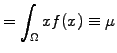
 =
\frac{1}{\sigma}\varphi\left(\frac{x-\mu}{\sigma}\right),
\hspace{1cm} \varphi(x)=\frac{1}{\sqrt{2\pi}}\exp(-x^2/2)$](s1img86.gif)

