SYLLABUS Previous: 1.5.2 Moving averages: UWMA,
Up: 1.5 Historical data and
Next: 1.6 Computer quiz
1.5.3 Maximum likelihood estimate of parameters
The material in this section is intended for students at a more advanced level than your profile
Even if a model provides an accurate description of statistical data, it is
important that occasional outliners be discarded from the fit. Instead of
minimizing a residual between the model and all the data points, a
maximum likelyhood estimation
therefore aims at maximizing the probability that the model reproduces most,
but not all the data points.
For example, imagine a coin thrown five times into the air with, as an
outcome 1 heads and 4 tails. The maximum likelyhood estimate of observing
the sequence in that order can be calculated by maximizing the probability
of the observation max[p(1-p)4]:
setting the derivative equal to zero (1-p)4-4p(1-p)3=0, this yields p=0.2
as expected.
The same method can be applied when the market increments are normally
distributed with a variance ni=si2
that is allowed to change over time. The maximum likelyhood of reproducing
the market data in that order can then be calculated from the optimum
![$\displaystyle \mathrm{max}\prod_{i=1}^m \left[ \frac{1}{\sqrt{2\pi\nu_i}}\exp\l...
...}(\chi), \quad \chi=\sum_{i=1}^m \left[ \ln(\nu_i) +\frac{u_i^2}{\nu_i} \right]$](s1img107.gif) |
(1.5.3#eq.1) |
where the second expression has been obtained after realizing that the
maximum of a quantity coincides with the maximum of its logarithm and
the minimum of the opposite. Model parameters, such as l in ni(l)
for the EWMA model of the volatility (1.5.2#eq.5) are then calculated
to maximize the likelihood of reproducing the data by setting the first
derivative equal to zero dC/dl=0
and keeping the second derivative positive d2C/dl2>0.
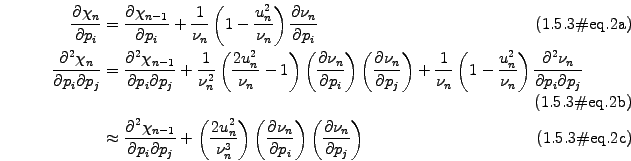
Even if several parameters have to be determined pi,pjÎ {a,b,...}
the gradient and the Hessian can be conveniently calculated from a sequence
where the last approximation guarantees a positive diagonal (i=j) when
using a Levenberg-Marquardt solver to locate the zeros of the non-linear
function (1.5.3#eq.2a).
The EWMA model (1.5.2#eq.5) has one free parameter (p1)l)
that can be estimated anew after every trading day. The link
below shows how the
derivatives of the variance
are updated before the
Levenberg-Marquardt algorithm
[18] is used to calculate the parameter as a zero of the non-linear
likelihood derivative (1.5.3#eq.2a). Note that a more simple Newton
algorithm for finding roots of scalar variables could have been used
instead, but would be insufficient when more than one parameter has to be
estimated.
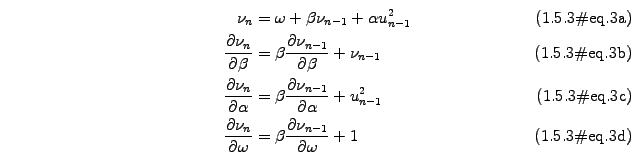
The GARCH(1,1) model (1.5.2#eq.6) has three free parameters (p1)b,
p2)a
p3)w)
and requires the evaluation of
the gradient
Maximum likelyhood of the fit is achieved when all three components of the
gradient are equal to zero, which defines the parameters using the same
Levenberg-Marquardt algorithm
to locate the zeros of (1.5.3#eq.2a).
The MKTSolution applet below illustrates how
the estimation works for the price history of the Asea Brown Boveri share
during 2001-2003, rapidly switching between different regimes that are
rather stable to produce the final estimate of
l=0.8891 for the EWMA model, and
w=0.000162, a=0.03134, b=0.8000
for the GARCH(1,1) model.
MKTSolution applet: select one or several of the
models (UWMA, EWMA, GARCH) to calculate the volatility of the ABB share
and press Draw to plot them as a function of the trading days
during the period May 2001 - April 2004.
You can perform measurements by clicking inside the plot area and access
up-to-date market data for a broad range of symbols under the previous
link.
|
|
It turns out parameter estimation is an important but rather delicate taskin the sense that the result depends strongly on the choice of the time
window and abrupt changes in the price history can lead to significant
changes in the model. This is of course what the estimation is meant to
do, but it is important to make sure that the values that are predicted
are not only mathematically correct, but also
financially meaningful.
Knowing the present value of the variance model parameters, it is possible
to forecast the financial risk into the future. Substituting the long term
average w=V(1-a-b)
into the recursive definition (1.5.2#eq.6), exercise 1.11 shows that the
expected value k days into the future becomes
![$\displaystyle E[\sigma_{n+k}^2]=V + (\alpha+\beta)^k(\sigma_n^2 -V)$](s1img111.gif) |
(1.5.3#eq.5) |
For the EWMA model a+b=1)
so that the expected future variance is equal to the present value.
For the GARCH model, a+b<1)
the second term decreases in importance for an increasing number of
days k, showing that the variance exhibits a
mean reversion
towards the level V at a rate 1-a-b)
.
An average of the variance term structure
![$\displaystyle \bar{\sigma^2}=\frac{1}{N}\sum_{k=0}^N E[\sigma_{n+k}^2]$](s1img112.gif) |
(1.5.3#eq.6) |
is then generally used to parametrize option pricing models.
SYLLABUS Previous: 1.5.2 Moving averages: UWMA,
Up: 1.5 Historical data and
Next: 1.6 Computer quiz
|