','..','$myPermit') ?>
SYLLABUS Previous: 3.5 Linear solvers
Up: 3 FINITE ELEMENT METHOD
Next: 3.7 Computer quiz
','..','$myPermit') ?>
SYLLABUS Previous: 3.5 Linear solvers
Up: 3 FINITE ELEMENT METHOD
Next: 3.7 Computer quiz
Consider the simplest obstacle problem, which arises when an
elastic string held fixed at both ends is pulled over a smooth object
and an equilibrium is sought without knowing a priori where are the
regions of contact between the string and this object.
Define the function
 measuring the
elevation of the string in the interval
measuring the
elevation of the string in the interval
![$ \Omega=[x_L;x_R]$](s3img153.gif) and the
function
and the
function
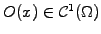 modeling the shape of the
object.
modeling the shape of the
object.
Mathematically, the obstacle problem amounts to finding a solution
 satisfying the conditions:
 ,
,
 (line of contact - in other words, the
obstacle can only push the string up, not pull it down).
(line of contact - in other words, the
obstacle can only push the string up, not pull it down).
 Linear complementary formulation.
 invertible and positive
definite, the linear problem
invertible and positive
definite, the linear problem
 .
.
For the obstacle problem, the string follows either a straight line
above the obstacle
 or fits exactly the object
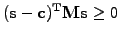
 ; this leads to a complementary problem
Variational formulation.
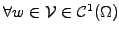 that satisfies the same constraints as the solution
 .
Having already
.
Having already
 and
and
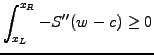
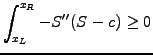
 , write two
inequalities
, write two
inequalities
 |
|||
 |
 now appears only implicitly through the fact that
 and
and  are members of the same sub-space
 ; all what
remains to be done is to prove that the inequality (3.6#eq.5)
in fact is a strict equality if the solution satisfies the constraint.
After integration by parts and discretization with linear FEMs, the
problem can therefore be solved with projected SOR iterations
(3.6#eq.3, exercises 3.05 and 3.07).
; all what
remains to be done is to prove that the inequality (3.6#eq.5)
in fact is a strict equality if the solution satisfies the constraint.
After integration by parts and discretization with linear FEMs, the
problem can therefore be solved with projected SOR iterations
(3.6#eq.3, exercises 3.05 and 3.07).
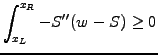
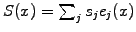
To prove that (3.6#eq.5) satisfies a strict equality, integrate by
part and a discretize
 and
and
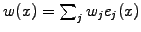 with linear finite elements
 |
 as is the case with
diffusion, this simply yields
as is the case with
diffusion, this simply yields
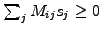 as is the case
with diffusion and the solution satisfies the constraint
as is the case
with diffusion and the solution satisfies the constraint
 ,
the product satisfies the inequality
,
the product satisfies the inequality
 ,
the last two inequalities can only be satisfied simultaneously if
they both satisfy the strict equality.
,
the last two inequalities can only be satisfied simultaneously if
they both satisfy the strict equality.
SYLLABUS Previous: 3.5 Linear solvers Up: 3 FINITE ELEMENT METHOD Next: 3.7 Computer quiz


![$\displaystyle \mathbf{x_{k+1}} = \max[\mathbf{c}, \omega \mathbf{x_{k}^{GS}} +(1-\omega) \mathbf{x_{k}} ]$](s3img160.gif)