','..','$myPermit') ?>
SYLLABUS Previous: 1.3.4 Wave-breaking
Up: 1.3 Prototype problems
Next: 1.4 Numerical discretization
','..','$myPermit') ?>
SYLLABUS Previous: 1.3.4 Wave-breaking
Up: 1.3 Prototype problems
Next: 1.4 Numerical discretization
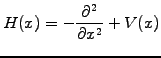
Choosing units where Planck's constant  and the mass
  ,
the time-dependent Schrödinger equation clearly appears as a
special type of wave / diffusion equation:
,
the time-dependent Schrödinger equation clearly appears as a
special type of wave / diffusion equation:
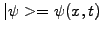 to describe the probability
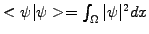 of finding a particle in a
given interval
of finding a particle in a
given interval
![$ \Omega=[x_L;x_R]$](s1img117.gif) .
Take the simplest example of a free particle modeled with a wave-packet
in a periodic domain and assume a constant potential
.
Take the simplest example of a free particle modeled with a wave-packet
in a periodic domain and assume a constant potential  .
The JBONE applet below shows the evolution
of a low energy
.
The JBONE applet below shows the evolution
of a low energy
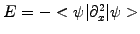 (long wavelength) particle
that is initially known with a rather good accuracy in space (narrow
Gaussian envelope):
(long wavelength) particle
that is initially known with a rather good accuracy in space (narrow
Gaussian envelope):
 (blue line) starts to oscillate, the
probability density
(blue line) starts to oscillate, the
probability density  spreads out (black line) and the position
increasingly becomes uncertain... reproducing the famous uncertainty
principle.
spreads out (black line) and the position
increasingly becomes uncertain... reproducing the famous uncertainty
principle.
SYLLABUS Previous: 1.3.4 Wave-breaking Up: 1.3 Prototype problems Next: 1.4 Numerical discretization