

 ','..','$myPermit') ?>
SYLLABUS Previous: 1.4.3 Finite elements
Up: 1.4 Numerical discretization
Next: 1.4.5 Harmonic functions
','..','$myPermit') ?>
SYLLABUS Previous: 1.4.3 Finite elements
Up: 1.4 Numerical discretization
Next: 1.4.5 Harmonic functions
Starting from an approximation on an inhomogeneous mesh, the idea of
splines is to provide a global interpolation that is continuous up to
a certain derivative.
For example, take a cubic Hermite spline with the 4 parameters
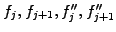 , which
completely determine all 4 coefficients of the cubic polynomial
, which
completely determine all 4 coefficients of the cubic polynomial
 |
 are usually calculated so as to guarantee a smooth
interpolation. Most common is to require that
are usually calculated so as to guarantee a smooth
interpolation. Most common is to require that
 be continuous
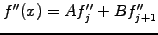
from one interval to the next, leading to a tridiagonal system that holds
for
be continuous
from one interval to the next, leading to a tridiagonal system that holds
for 
 operations.
Two free parameters at the boundaries are used to impose the
boundary conditions by choosing
operations.
Two free parameters at the boundaries are used to impose the
boundary conditions by choosing
 and
and
 (1.4.4#eq.2).
Figure (1.4.4#fig.1) illustrates the procedure and shows the excellent
quality of a cubic approximation until it breaks down at the limit of 2
mesh points per wavelength.
(1.4.4#eq.2).
Figure (1.4.4#fig.1) illustrates the procedure and shows the excellent
quality of a cubic approximation until it breaks down at the limit of 2
mesh points per wavelength.
SYLLABUS Previous: 1.4.3 Finite elements Up: 1.4 Numerical discretization Next: 1.4.5 Harmonic functions



 with cubic Hermite splines.
![\includegraphics[width=10cm]{figs/AprxSPL.psc}](s1img196.gif)