','..','$myPermit') ?>
SYLLABUS Previous: 1.4.6 Wavelets
Up: 1.4 Numerical discretization
Next: 1.5 Computer quiz
','..','$myPermit') ?>
SYLLABUS Previous: 1.4.6 Wavelets
Up: 1.4 Numerical discretization
Next: 1.5 Computer quiz
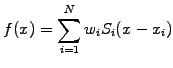
A completely different way of approximating a function is to use a statistical sampling with quasi-particles
 is the weight,
  the shape, and
  the position of
each particle.
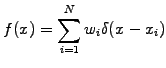
In the JBONE applet, the particle shapes are assumed to be
Dirac pulses
the position of
each particle.
In the JBONE applet, the particle shapes are assumed to be
Dirac pulses
 , meaning that the particles are
localized in an infinitely small interval around
, meaning that the particles are
localized in an infinitely small interval around
 |
(1.4.7#eq.2) |
 .
As a matter of fact, this form of discretization does never converge
locally, since the Dirac pulses are either zero or infinite.
However, the ``global properties'' (or moments) of a smooth and
bounded function
.
As a matter of fact, this form of discretization does never converge
locally, since the Dirac pulses are either zero or infinite.
However, the ``global properties'' (or moments) of a smooth and
bounded function  discretized with Dirac pulses does converge
 in an
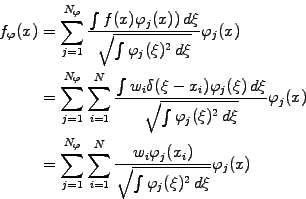
assignment process, which attributes a statistical average to a grid:
in an
assignment process, which attributes a statistical average to a grid:
![\includegraphics[width=8cm]{figs/ProjectionBase.eps}](s1img236.gif)
|
Try to press INITIALIZE a
few times to get a feeling how good a quasi-particle approximation is to
approximate a box with 64 grid points and a varying number of particles
(random walkers).
You need however to be patient if you exceed  particles... the
JAVA virtual machines in the web browsers are usually rather
slow!
particles... the
JAVA virtual machines in the web browsers are usually rather
slow!
 with a
range
with a
range
![$ \left[f_{\text{min}}, f_{\text{max}}\right]$](s1img239.gif) in the interval
in the interval ![$ [a,b]$](s1img240.gif) following the procedure
following the procedure
LetThis algorithm produces a particle density in the interval
while
Let
be a uniformly distributed random number in the interval
be a uniformly distributed random number in the interval
then let
and advance
by 1 else do nothing.
end while
![$ [a; b]$](s1img247.gif) that is proportional to the initial condition
that is proportional to the initial condition
 .
.
SYLLABUS Previous: 1.4.6 Wavelets Up: 1.4 Numerical discretization Next: 1.5 Computer quiz