','..','$myPermit') ?>
SYLLABUS Previous: 1.2 Differential Equations
Up: 1.2 Differential Equations
Next: 1.2.2 Partial differential equations
','..','$myPermit') ?>
SYLLABUS Previous: 1.2 Differential Equations
Up: 1.2 Differential Equations
Next: 1.2.2 Partial differential equations
Rather than repeating details of elementary numerical analysis, this section is only meant to review a few methods that will be used later, e.g. in the chapter dealing with the Monte Carlo method for partial differential equations (PDE).
Ordinary differential equations (ODE) are often encountered when dealing with initial value problems. In Newtonian mechanics, for example, the trajectory of a particle is described by an evolution in time
 having
the same number of components as the unknown vector
having
the same number of components as the unknown vector  yields exactly
one solution to (1.2.1#eq.1), which can then be approximated with a
computer.
yields exactly
one solution to (1.2.1#eq.1), which can then be approximated with a
computer.
Introducing a discretization
 with a finite number
  of
time steps
of
time steps
 , a straight forward manner to solve an ODE is
to approximate the derivative with a finite difference quotient forward
in time
, a straight forward manner to solve an ODE is
to approximate the derivative with a finite difference quotient forward
in time
 , leading to the
Euler recursion formula
, leading to the
Euler recursion formula
 , the scheme is said
to be explicit. An implicit evaluation of the function
, the scheme is said
to be explicit. An implicit evaluation of the function
 is sometimes desirable in order to stabilize the
propagation of numerical errors; this is however computationally
expensive when the function cannot be inverted analytically.
is sometimes desirable in order to stabilize the
propagation of numerical errors; this is however computationally
expensive when the function cannot be inverted analytically.
More precision can be obtained by using a finite difference quotient
symmetric in time
 ,
which is obtained by summing two Taylor series forward and backward
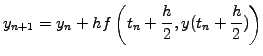
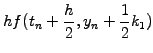
(exercise 1.02). This yields the so-called midpoint formula
,
which is obtained by summing two Taylor series forward and backward
(exercise 1.02). This yields the so-called midpoint formula
SYLLABUS Previous: 1.2 Differential Equations Up: 1.2 Differential Equations Next: 1.2.2 Partial differential equations