','..','$myPermit') ?>
SYLLABUS Previous: 3.1 Mathematical background
Up: 3 FINITE ELEMENT METHOD
Next: 3.3 Numerical quadrature
','..','$myPermit') ?>
SYLLABUS Previous: 3.1 Mathematical background
Up: 3 FINITE ELEMENT METHOD
Next: 3.3 Numerical quadrature
After a section on what a physicist believes is a mathematician's view of the subject, it is time for an example. Using the format of a ``recipe'' that is applicable to a broad class of practical problems, we show here how the advection-diffusion equation (1.3.2#eq.2) is discretized using Galerkin linear finite elements (FEMs) and how it is implemented.
 Derive a weak variational form.
 where the
complex conjugate is necessary only if your equation(s) is (are) complex
where the
complex conjugate is necessary only if your equation(s) is (are) complex
![$\displaystyle \forall g\in \mathcal{C}^1(\Omega),\hspace{1cm} \int_{x_L}^{x_R} ...
...+u\frac{\partial f}{\partial x} -D\frac{\partial^2 f}{\partial x^2} \right] = 0$](s3img38.gif) |
(1) |
Integrate by parts,
 |
(2) |
Discretize time
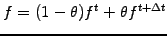 where
where
![$ \theta\in[1/2;1]$](s3img41.gif)
![$\displaystyle \int_{x_L}^{x_R} dx \left[ g\left(\frac{f^{t+\Delta t}-f^t}{\Delt...
...ial}{\partial x} \left[(1-\theta)f^t + \theta f^{t+\Delta t}\right] \right] = 0$](s3img42.gif) |
![$\displaystyle \int_{x_L}^{x_R}\!\!dx \left[ \frac{g}{\Delta t} +\theta ug\frac{...
...!\theta) D \frac{\partial g}{\partial x}\frac{\partial}{\partial x} \right] f^t$](s3img43.gif) |
(3) |
 . All the unknowns have been reassembled on the left.
Re-scale by
. All the unknowns have been reassembled on the left.
Re-scale by  , and
Discretize space
, and
Discretize space
 |
(4) |
![$ \forall g\in \mathcal{C}^1([x_L; x_R])$](s3img52.gif) is here
used to create as many independent equations
is here
used to create as many independent equations  as there are unknowns
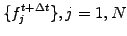 .
All the essential boundary conditions are then imposed by allowing
.
All the essential boundary conditions are then imposed by allowing
 and
and  to overlap in the periodic domain.
Since only the basis and test functions
to overlap in the periodic domain.
Since only the basis and test functions
 and perhaps the
problem coefficients
and perhaps the
problem coefficients
 remain space dependent, the discretized
equations are all written in terms of inner products, involving
overlap integrals of the form
remain space dependent, the discretized
equations are all written in terms of inner products, involving
overlap integrals of the form
 .
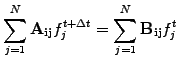
Reassembling them all in a matrix,
Write a linear system
.
Reassembling them all in a matrix,
Write a linear system
 can implicitly be obtained from the current values
  by solving a
linear system
by solving a
linear system
To relate the Galerkin linear FEM scheme (3.2#eq.5) with the code
that has been implemented in the JBONE applet, it is necessary
now to evaluate the overlap integrals.
This is usually performed numerically using a quadrature. In the case of
a homogeneous mesh
 , a constant advection
  and
diffusion coefficient
and
diffusion coefficient  , the coming section shows how explicit
expressions can be obtained from the same rules to define directly the
matrix elements.
, the coming section shows how explicit
expressions can be obtained from the same rules to define directly the
matrix elements.
SYLLABUS Previous: 3.1 Mathematical background Up: 3 FINITE ELEMENT METHOD Next: 3.3 Numerical quadrature


![$\displaystyle \left[
e_i\sum_{j=1}^N f_j^{t+\Delta t} e_j
+\Delta t\theta e_i u...
...tial x}
\sum_{j=1}^N f_j^{t+\Delta t} \frac{\partial e_j}{\partial x}
\right] =$](s3img49.gif)
![$\displaystyle \left[
e_i\sum_{j=1}^N f_j^{t } e_j
+\Delta t(\theta-1) e_i u \su...
... e_i}{\partial x}
\sum_{j=1}^N f_j^{t } \frac{\partial e_j}{\partial x}
\right]$](s3img50.gif)