

 ','..','$myPermit') ?>
SYLLABUS Previous: 3.2 An engineer's formulation
Up: 3 FINITE ELEMENT METHOD
Next: 3.4 Implementation and solution
','..','$myPermit') ?>
SYLLABUS Previous: 3.2 An engineer's formulation
Up: 3 FINITE ELEMENT METHOD
Next: 3.4 Implementation and solution
Unless the coefficients of the differential equation (here  and
and  )
are singular and require a special treatment somewhere in the solution
domain, the precision of the quadrature depends mainly on the choice of
the basis and test functions: it is indeed sufficient to simply preserve
the convergence rate that is guaranteed by the FEM discretization.
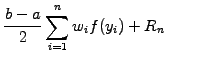
Writing the numerical quadrature as a truncated sum
)
are singular and require a special treatment somewhere in the solution
domain, the precision of the quadrature depends mainly on the choice of
the basis and test functions: it is indeed sufficient to simply preserve
the convergence rate that is guaranteed by the FEM discretization.
Writing the numerical quadrature as a truncated sum
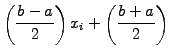
 and weights
  yields an approximation of
 that integrates exactly polynomials with a degree up to
  .
.
|
For example, a superposition of  terms (where the integrand is
evaluated on the specified location
terms (where the integrand is
evaluated on the specified location
![$ y_i(x_i)\in[a;b]$](s3img86.gif) and weighted
by the factor
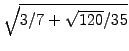
) is required using a Gaussian quadrature, when
four evaluations of the integrand in every mesh interval are used
to compute exact overlap integrals involving the product of (two)
cubic test and basis functions.
In the case of linear roof-top functions, the mid-point and trapezoidal
rules are both equally precise and require only one evaluation per interval;
although this is slightly more expensive with one extra evaluation per
interval, both rules can nicely be combined into a so-called
tunable integration [8]
and weighted
by the factor
) is required using a Gaussian quadrature, when
four evaluations of the integrand in every mesh interval are used
to compute exact overlap integrals involving the product of (two)
cubic test and basis functions.
In the case of linear roof-top functions, the mid-point and trapezoidal
rules are both equally precise and require only one evaluation per interval;
although this is slightly more expensive with one extra evaluation per
interval, both rules can nicely be combined into a so-called
tunable integration [8]
 ) into either an equivalent
FD discretization (with
) into either an equivalent
FD discretization (with  ) or a piecewise constant FEM approximation
(with
) or a piecewise constant FEM approximation
(with  ).
Apart from the academic interest, this feature can be used to change the
slope of the numerical convergence and even to stabilize an approximation
that is marginally unstable.
).
Apart from the academic interest, this feature can be used to change the
slope of the numerical convergence and even to stabilize an approximation
that is marginally unstable.
Armed with a variety of quadrature rules, it is now possible to implement
the linear FEM scheme sketched in sect.3.2 using a tunable integration
(3.3#eq.3) to evaluate the matrix elements in (3.2#eq.5).
Since roof-top functions reach only as far as their
nearest neighbors,
all the matrix elements
 with
with  vanish, except
for the overlap at the boundaries.
Choosing a sequential numbering of the unknowns
vanish, except
for the overlap at the boundaries.
Choosing a sequential numbering of the unknowns
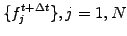 ,
this results in a tri-diagonal matrix, with two extra elements in the
upper-right and lower left corner taking care of the periodicity.
It is a good exercise for the reader to verify that all the matrix elements
can be written in terms of the integrals
,
this results in a tri-diagonal matrix, with two extra elements in the
upper-right and lower left corner taking care of the periodicity.
It is a good exercise for the reader to verify that all the matrix elements
can be written in terms of the integrals
 function calls returning the value of the integrand
(where
function calls returning the value of the integrand
(where  ,
,  are evaluated on quadrature points) and the
weighted sum (3.3#eq.1) is simply accumulated in the corresponding
matrix element.
are evaluated on quadrature points) and the
weighted sum (3.3#eq.1) is simply accumulated in the corresponding
matrix element.
SYLLABUS Previous: 3.2 An engineer's formulation Up: 3 FINITE ELEMENT METHOD Next: 3.4 Implementation and solution



![$ x_i\in [-1;1]$](s3img5.gif)


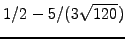
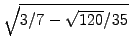
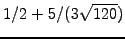
![$\displaystyle \int_a^b f(y) dy = (b-a)\left[\frac{p}{2}\left[f(a)+f(b)\right] + (1-p) f\left(\frac{a+b}{2}\right)\right] + R_2, \hspace{5mm}p\in[0;1]$](s3img87.gif)



