','..','$myPermit') ?>
SYLLABUS Previous: 3.3 Numerical quadrature
Up: 3 FINITE ELEMENT METHOD
Next: 3.5 Linear solvers
','..','$myPermit') ?>
SYLLABUS Previous: 3.3 Numerical quadrature
Up: 3 FINITE ELEMENT METHOD
Next: 3.5 Linear solvers
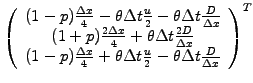
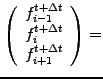
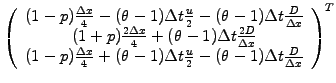
Substituting the overlap integrals (3.3#eq.4) into (3.2#eq.5)
yields the FEM scheme
      BandMatrix a = new BandMatrix(3, f.length);
      BandMatrix b = new BandMatrix(3, f.length);
      double[]   c = new double[f.length];
      double h   = dx[0];
      double htm = h*(1-tune)/4;
      double htp = h*(1+tune)/4;

      for (int j=0; j<=n; j++) {
        a.setL(j,   htm +h*(-0.5*beta -alpha)* theta    );
        a.setD(j,2*(htp +h*(           alpha)* theta   ));
        a.setR(j,   htm +h*( 0.5*beta -alpha)* theta    );
        b.setL(j,   htm +h*(-0.5*beta -alpha)*(theta-1) );
        b.setD(j,2*(htp +h*(           alpha)*(theta-1)));
        b.setR(j,   htm +h*( 0.5*beta -alpha)*(theta-1) );
      }
      c=b.dot(f);                                 //Right hand side
      c[0]=c[0]+b.getL(0)*f[n];                   // with periodicity
      c[n]=c[n]+b.getR(n)*f[0];

      fp=a.solve3(c);                             //Solve linear problem
Here again, the
BandMatrix.solve3()
method is used to compute a direct solution in
 operations,
using an LU-factorization that will be examined with
more details in the coming section.
The entire scheme is illustrated below with the
advection of a box function, calculated using a piecewise linear FEM
discretization (with
operations,
using an LU-factorization that will be examined with
more details in the coming section.
The entire scheme is illustrated below with the
advection of a box function, calculated using a piecewise linear FEM
discretization (with  ) and a partly implicit time integration
(with
) and a partly implicit time integration
(with
 ).
).
Having spent a considerable effort understanding the FEM formulation,
isn't it frustrating to see how similar the code is to the implicit
Crank-Nicholson FD scheme in sect.2.5?
This should be the main argument for the community who still uses
implicit finite difference schemes: with a little bit of thinking but
the same computational cost, the finite element scheme is now
considerably more flexibile: it is for example easy to densify the mesh16, modify the partly implicit time integration from centered to fully
implicit
![$ \theta\in[\frac{1}{2};1]$](s3img106.gif) and tune the integration
and tune the integration ![$ p\in[0;1]$](s3img108.gif) .
Convince yourself that
Crank-Nicholson
(2.5.1#eq.12) and this
FEM scheme
(3.4#eq.1) are indeed equivalent when using a homogeneous mesh
.
Convince yourself that
Crank-Nicholson
(2.5.1#eq.12) and this
FEM scheme
(3.4#eq.1) are indeed equivalent when using a homogeneous mesh
 , a time centered integration
 and a trapezoidal quadrature
  .
.
SYLLABUS Previous: 3.3 Numerical quadrature Up: 3 FINITE ELEMENT METHOD Next: 3.5 Linear solvers