','..','$myPermit') ?>
SYLLABUS Previous: 2.1 The stock market
Up: 2.1 The stock market
Next: 2.1.2 Forward contract and
','..','$myPermit') ?>
SYLLABUS Previous: 2.1 The stock market
Up: 2.1 The stock market
Next: 2.1.2 Forward contract and
Small companies generally start developing a product using private resources and sometimes a limited amount of venture capital. If all goes well, they may under circumstance decide to go to the stock market for the quest of new capital, which will allow them to grow more rapidly than what they could achieve by simply re-investing their own earnings.
Investment banks assist them in the initial public offering (IPO), when the company value (often estimated for the future potential more than the present earnings) is divided in a number of shares that are proposed to the investors on the stock market. By selling a fraction of their company, the original owners realize a capital gain, but also give up part of the control and future earnings to other shareholders. After a rapid and rather systematic evolution (depending on how well the investment bank succeeds in aligning the initial offering with the market expectations), the share price starts a dominantly random evolution in agreement with Fama's efficient market hypothesis introduced in section 1.4.
Previous experiments with the VMARKET applet suggested that possible realizations for the price of a share can be simulated by adding small increments to the initial price that is known. To be precise, the market (or spot) value can never be predicted with certainty, but an expected value can nevertheless be calculated, provided that the distribution of increments reproduces the market characteristics.
In addition to the deterministic growth (Drift parameter  ) and the
random component associated with risk (Volatility parameter
) and the
random component associated with risk (Volatility parameter  ),
statistical analysis unveils a significant difference between the stock and
the bond prices: the share price increments have a
log-normal distribution,
while the spot rate increments tend to have a more
normal distribution.
In other words, a share presently at EUR 10 is as likely to double in value
to EUR 20 as it is to divide by two down to EUR 5.
This in contrast with interest rates at 10%, which are as likely to rise
(to 15%) or fall (to 5%) by the same amount.
The VMARKET applet below illustrates the
difference between the two distributions, assimilating the random
horizontal motion of a red dot with the price of a share in a volatile
market.
),
statistical analysis unveils a significant difference between the stock and
the bond prices: the share price increments have a
log-normal distribution,
while the spot rate increments tend to have a more
normal distribution.
In other words, a share presently at EUR 10 is as likely to double in value
to EUR 20 as it is to divide by two down to EUR 5.
This in contrast with interest rates at 10%, which are as likely to rise
(to 15%) or fall (to 5%) by the same amount.
The VMARKET applet below illustrates the
difference between the two distributions, assimilating the random
horizontal motion of a red dot with the price of a share in a volatile
market.
$](s2img48.gif) (1.4#eq.5) to simulate
relatively large time steps longer than one month.
Very little programming experience is needed to understand how the
log-normal walk (the position or the price) of a single particle has
been
implemented in VMARKET
applet using the scheme
(1.4#eq.5) to simulate
relatively large time steps longer than one month.
Very little programming experience is needed to understand how the
log-normal walk (the position or the price) of a single particle has
been
implemented in VMARKET
applet using the scheme
      double mu      = runData.getParamValue("Drift");
      double sigma   = runData.getParamValue("Volatility");

      for(int j=0; j<numberOfRealisations; j++){
        currentState[j][0] += currentState[j][0] *
              ( mu*timeStep +
                random.nextGaussian()*sigma*Math.sqrt(timeStep) );
      }
For those who are not familiar with Java or C++ coding conventions, note
that x+=1.0 increments the variable x by the real value one
and j++ increments the variable j by the integer value one after
using it for evaluation.
Choosing the input parameter Drift=0.0 in the applet also sets
mu=0.0, so that the normally distributed random number
![$ \mathcal{N}[0,1]$](s2img49.gif) obtained from the function
obtained from the function random.nextGaussian()
is here simply scaled by the current position to simulate a log-normal
distribution of the increments without drift.
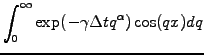
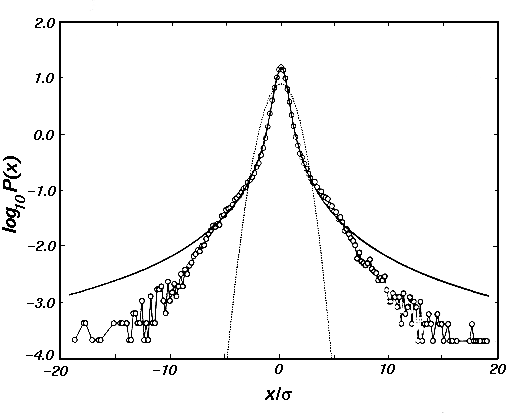
![$ P(0)\equiv L_\alpha(0,\Delta t) =
\Gamma(1/\alpha)/(\pi\alpha\sqrt[\alpha]{\gamma\Delta t})$](s2img52.gif) with an index
with an index  =1.40 have been used in Ref.[15] to first
calculate the scaling factor
=1.40 have been used in Ref.[15] to first
calculate the scaling factor  =0.00375 and then reproduce nearly
three orders of magnitude of the ``fat tails'' of a leptokurtotic
distribution in (2.1.1#fig.1), here measured from spot price increments
over time intervals as short as one minute.
=0.00375 and then reproduce nearly
three orders of magnitude of the ``fat tails'' of a leptokurtotic
distribution in (2.1.1#fig.1), here measured from spot price increments
over time intervals as short as one minute.
|
At least some investors have to believe that the price of a share will rise more rapidly than the return they can earn overnight from a deposit at a spot rate, which carries little or no risk at all. A risk premium in the range 3-8% is usually added to the 0-2% spot rate to account for a positive drift proportional to the share value (e.g. Drift=SpotRate+0.04).
A fixed dividend payment  per share is often made each year after
the shareholder's assembly; for simplicity, this can be modeled as a
continuous dividend yield
per share is often made each year after
the shareholder's assembly; for simplicity, this can be modeled as a
continuous dividend yield  in the range 1-4% and contributes
with a negative drift to the spot price, since the payments reduce
the total value of the company (e.g. Drift=SpotRate-Dividend,
see exercise 2.02).
in the range 1-4% and contributes
with a negative drift to the spot price, since the payments reduce
the total value of the company (e.g. Drift=SpotRate-Dividend,
see exercise 2.02).
Before we conclude this short introduction on the modeling of the prices on the stock market, simply note that any combination of shares can be used to form a weighted average called market index: the most famous such as the Dow Jones and NASDAQ 100 in the US, the FTSE 100 (Financial Times Stock Exchange, pronounce ``footsee'') in the UK and the Nikkei 225 in Japan combine the largest and most prestigious companies (so called ``blue chips'' - the name stems from the game of poker where the blue chip have the highest value) in a country and provide a measure of the economic growth of a nation.
SYLLABUS Previous: 2.1 The stock market Up: 2.1 The stock market Next: 2.1.2 Forward contract and