

 ','..','$myPermit') ?>
SYLLABUS Previous: 1.4.2 Sampling on a
Up: 1.4 Numerical discretization
Next: 1.4.4 Splines
','..','$myPermit') ?>
SYLLABUS Previous: 1.4.2 Sampling on a
Up: 1.4 Numerical discretization
Next: 1.4.4 Splines
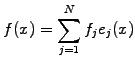
Following the spirit of Hilbert space methods, a function  is
decomposed on a complete set of nearly orthogonal basis functions
is
decomposed on a complete set of nearly orthogonal basis functions

and a piecewise
constant derivative
 that is defined almost everywhere in
the interval
that is defined almost everywhere in
the interval ![$ [x_1;x_N]$](s1img182.gif) .
Boundary conditions are imposed by modifying the functional space
.
Boundary conditions are imposed by modifying the functional space
 , e.g. by taking ``unilateral roofs'' at the boundaries.
Generalizations with ``piecewise constant'' or higher order ``quadratic'' and ``cubic'' FEM are constructed along the same lines. The capability of densifying the mesh where short spatial scales require a higher accuracy is of particular interest. Figure (1.4.3#fig.1) doesn't exploit this, showing instead what happens when the numerical resolution becomes insufficient: around 20 linear or 2 cubic FEM are typically required per wavelength to achieve a precision around 1%. A minimum of 2 is of course necessary to resolve the oscillation.
SYLLABUS Previous: 1.4.2 Sampling on a Up: 1.4 Numerical discretization Next: 1.4.4 Splines
![$\displaystyle e_j(x)=\left\{ \begin{array}{c} (x-x_{j-1})/(x_j-x_{j-1}) \hspace...
...\ (x_{j+1}-x)/(x_{j+1}-x_j) \hspace{5mm} x\in[x_j; x_{j+1}] \end{array} \right.$](s1img180.gif)
 with homogeneous linear finite elements.
![\includegraphics[width=10cm]{figs/AprxFEM.psc}](s1img184.gif)