

 ','..','$myPermit') ?>
SYLLABUS Previous: 1.4.4 Splines
Up: 1.4 Numerical discretization
Next: 1.4.6 Wavelets
','..','$myPermit') ?>
SYLLABUS Previous: 1.4.4 Splines
Up: 1.4 Numerical discretization
Next: 1.4.6 Wavelets
A harmonic decomposition is obtained from a discrete Fourier transform
(DFT) assuming a regular mesh and a periodic domain of length  .
Using the notations
.
Using the notations
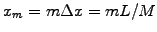 and
and
 , the
forward and backward transformations are defined as
, the
forward and backward transformations are defined as
 |
 |
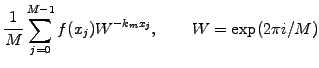 |
(1.4.5#eq.1) |
 |
|
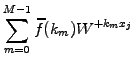 |
(1.4.5#eq.2) |
 is a power of 2, the total number of operations can be dramatically
reduced from
is a power of 2, the total number of operations can be dramatically
reduced from  to
to  in a fast Fourier transform (FFT),
by applying recursively the decomposition
in a fast Fourier transform (FFT),
by applying recursively the decomposition
|
|
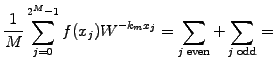 |
|
|
 |
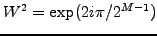 until a sum of DFT of length
  is obtained.
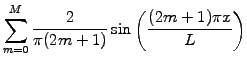
Figure (1.4.5#fig.1) illustrates how the approximation of a periodic
square wave converges with an increasing number of Fourier components.
Note how the function overshoots in the neighborhood of sharp edges: this is
the Gibbs phenomenon and it will always be there for a finite number
of terms in the sum.
is obtained.
Figure (1.4.5#fig.1) illustrates how the approximation of a periodic
square wave converges with an increasing number of Fourier components.
Note how the function overshoots in the neighborhood of sharp edges: this is
the Gibbs phenomenon and it will always be there for a finite number
of terms in the sum.
It should not be surprizing to hear that a harmonic decomposition
is particularly well suited for smooth global functions with long
wavelengths
 , since they result in a narrow spectrum
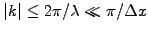 .
Note that the convergence with an increasing number of Fourier components
is faster than any polynomial once the smallest structure has been resolved.
The implementation of non-periodic boundary conditions, however, can
sometimes be problematic.
.
Note that the convergence with an increasing number of Fourier components
is faster than any polynomial once the smallest structure has been resolved.
The implementation of non-periodic boundary conditions, however, can
sometimes be problematic.
SYLLABUS Previous: 1.4.4 Splines Up: 1.4 Numerical discretization Next: 1.4.6 Wavelets
 with
with  .
.![\includegraphics[width=10cm]{figs/AprxFFT.psc}](s1img211.gif)