','..','$myPermit') ?>
SYLLABUS Previous: 3 FINITE ELEMENT METHOD
Up: 3 FINITE ELEMENT METHOD
Next: 3.2 An engineer's formulation
','..','$myPermit') ?>
SYLLABUS Previous: 3 FINITE ELEMENT METHOD
Up: 3 FINITE ELEMENT METHOD
Next: 3.2 An engineer's formulation
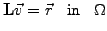
To approximate a set of linear partial differential equations
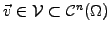 that is
continuously defined with
that is
continuously defined with  derivatives in the volume
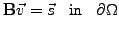
  and is
subject to the boundary conditions
and is
subject to the boundary conditions
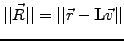
 Weighted residuals.
 and a norm
  ,
the calculation essentially amounts to the minimization of a residual
vector
Variational principle.
,
the calculation essentially amounts to the minimization of a residual
vector
Variational principle.
 in a sub-space
 that is
``sufficiently general'' and satisfies the boundary conditions.
The linear equation (3.1#eq.1) can then be written as an
equivalent variational problem
Integration by parts.
is differentiable at least once in
that is
``sufficiently general'' and satisfies the boundary conditions.
The linear equation (3.1#eq.1) can then be written as an
equivalent variational problem
Integration by parts.
is differentiable at least once in
 , the regularity required by
the forth-coming discretization can often be relaxed by partial integrations.
Using
, the regularity required by
the forth-coming discretization can often be relaxed by partial integrations.
Using
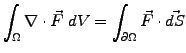
 for illustration, Leibniz' rule states that
and using Gauss' divergence theorem
for illustration, Leibniz' rule states that
and using Gauss' divergence theorem
 , this is known as Green's
formula
Numerical approximation.
, this is known as Green's
formula
Numerical approximation.
 of (3.1#eq.4) remains a
converging approximation of (3.1#eq.1) even when the sub-spaces
of (3.1#eq.4) remains a
converging approximation of (3.1#eq.1) even when the sub-spaces
 are restricted to finite, a priori non-orthogonal,
but still complete sets
are restricted to finite, a priori non-orthogonal,
but still complete sets
 of functions. The overlap integrals involving non-orthogonal functions
are often evaluated with a numerical quadrature that can be easily be
handled by the computer.
of functions. The overlap integrals involving non-orthogonal functions
are often evaluated with a numerical quadrature that can be easily be
handled by the computer.
In general, the discretized solution
is expanded in basis
functions
 , which
either reflect a property of the solution (e.g. the operator
Green's function in the Method of Moments),
or which are simple and localized enough so that they yields cheap inner
products
, which
either reflect a property of the solution (e.g. the operator
Green's function in the Method of Moments),
or which are simple and localized enough so that they yields cheap inner
products
 and sparse linear systems (e.g. the
roof-top function for the linear Finite Element Method).
Different choices can also be made for the test functions
:
among the most popular are the Galerkin method, where test and basis
functions are both chosen from the same sub-space
and sparse linear systems (e.g. the
roof-top function for the linear Finite Element Method).
Different choices can also be made for the test functions
:
among the most popular are the Galerkin method, where test and basis
functions are both chosen from the same sub-space
 and the method of
collocation, which consists in taking Dirac functions
and the method of
collocation, which consists in taking Dirac functions
 that lead to point-wise evaluations of the integrand on the mesh
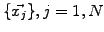 .
.
Boundary conditions.
(e.g. let  and
and  overlap in a periodic domain
![$ [x_1; x_n]$](s3img36.gif) as in the next section) or by replacing one or several
equations of the linear system (e.g. use higher order finite differences
to preserve the convergence rate as in exercise 3.02).
as in the next section) or by replacing one or several
equations of the linear system (e.g. use higher order finite differences
to preserve the convergence rate as in exercise 3.02).
SYLLABUS Previous: 3 FINITE ELEMENT METHOD Up: 3 FINITE ELEMENT METHOD Next: 3.2 An engineer's formulation