

 ','..','$myPermit') ?>
SYLLABUS Previous: 5.1 Monte Carlo integration
Up: 5 MONTE-CARLO METHOD
Next: 5.3 Particle orbits
','..','$myPermit') ?>
SYLLABUS Previous: 5.1 Monte Carlo integration
Up: 5 MONTE-CARLO METHOD
Next: 5.3 Particle orbits
This section is intended as a very short introduction into the stochastic theory, which provides the mathematical foundation behind the Monte Carlo method; check Sczepessy [28], Kloeden [22] and Van Kampen [20] for complete courses on the subject.
To begin, remember the definition of an expected or mean value
 and the variance

 \triangleq$](s5img17.gif) |
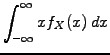 |
(1) |
 \triangleq$](s5img19.gif) |
![$\displaystyle \, \mathcal{E}\left[X\right]\left(\left(x- \mathcal{E}[X]\left(x\right)\right)^2\right)$](s5img20.gif) |
(2) |
 |
![$\displaystyle \mathcal{E}\left[X\right]\left(x^2\right) - \mathcal{E}^2\left[X\right](x)$](s5img22.gif) |
(3) |
 is the density distribution function of a stochastic
variable
is the density distribution function of a stochastic
variable  .
The notation
.
The notation
 refers to the set of Gaussian
or normally distributed stochastic variable
with a density
distribution function
refers to the set of Gaussian
or normally distributed stochastic variable
with a density
distribution function
![$\displaystyle f_X(x)=\frac{1}{\sigma\sqrt{2\pi}} \exp\left[-\frac{(x-\mu)^2}{2\sigma^2}\right]$](s5img26.gif) |
(4) |
 is the mean and
  is the variance.
Along the same lines,
is the variance.
Along the same lines,
 stands for the set of uniformly
distributed random numbers in the interval
stands for the set of uniformly
distributed random numbers in the interval ![$ [a,b]$](s5img10.gif) .
.
Now consider a class of stochastic processes that play a central role in
the Monte Carlo method:  is called a Wiener process (or in an
equivalent manner Brownian motion) at a time
is called a Wiener process (or in an
equivalent manner Brownian motion) at a time  if and only if
 ,
where
,
where
 is the set of normal distributed random numbers.
![$ \mathcal{E}[W_tdW_t]=\mathcal{E}[W_t]\mathcal{E}[dW_t]$](s5img34.gif) ,
where
denotes expected value,
,
where
denotes expected value,
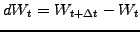 and
and
 , i.e. the Wiener increment
  is independent
of the past.
is independent
of the past.
It turns out that the distribution of Wiener increments
 is essentially the same function as the Green's function of the diffusion
equation (1.3.2#eq.3).
is essentially the same function as the Green's function of the diffusion
equation (1.3.2#eq.3).
The differential calculus of stochastic processes (or
Itô calculus) involves new properties that are fundamentally
different from the ordinary (or Riemann) calculus. The reason can be
tracked down to the preferred direction of time
in the
Itô integral, which is defined as the limit of the explicit
(forward Euler) discretization
![$ \{ t_i:t_i \in [0,T], t_{i+1}=t_i+\Delta t_i \}$](s5img40.gif) .
Note that the circle
.
Note that the circle  here stands for Itô differential and states
that
is independent of
here stands for Itô differential and states
that
is independent of  ; also, an implicit discretization
in (5.2#eq.5) would give a fundamentally different result.
; also, an implicit discretization
in (5.2#eq.5) would give a fundamentally different result.
Define a property  that is a sum of a Riemann and an Itô integral
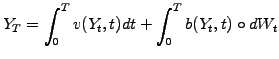 |
(6) |
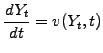 |
(8) |
SYLLABUS Previous: 5.1 Monte Carlo integration Up: 5 MONTE-CARLO METHOD Next: 5.3 Particle orbits

