

 ','..','$myPermit') ?>
SYLLABUS Previous: 6.1 Splitting advection from
Up: 6 LAGRANGIAN METHOD
Next: 6.3 Non-Linear equations with
','..','$myPermit') ?>
SYLLABUS Previous: 6.1 Splitting advection from
Up: 6 LAGRANGIAN METHOD
Next: 6.3 Non-Linear equations with
Introduced a decade ago by Yabe and Aoki [34], a whole family of schemes have been proposed along the same lines, relying on different interpolations to propagate the solution along the characteristics.
Using a cubic-Hermite polynomial, the discretized function and its first
derivative
 is approximated in a continuous
manner with
is approximated in a continuous
manner with
![$\displaystyle \displaystyle
F_j(x)=\left[(a_j X -b_j)X + \Delta x f_j^\prime\right]X +f_j\; ; \hspace{7mm}$](s6img11.gif) |
 |
||
 |
 |
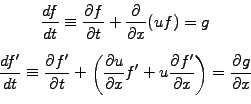
 satisfy the master advection equation
 |
(1) |
![$\displaystyle \left\{ \begin{array}{l} \displaystyle\frac{df}{dt}= 0\\ [5mm] \d...
...rtial g}{\partial x} -\frac{\partial u}{\partial x}f^\prime \end{array} \right.$](s6img17.gif) |
(2) |
 along the characteristics
 (exercise 6.01).
For pedagogical reasons, the scheme implemented in JBONE
assumes that
![$ \beta\in[0;1]$](s6img21.gif) so that both quantities
so that both quantities
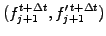 can be interpolated from only one piece of the piecewise continuous
polynomial, namely
can be interpolated from only one piece of the piecewise continuous
polynomial, namely  defined in the interval
![$ [x_j;x_{j+1}]$](s6img24.gif) .
After an initialization where the
function is discretized
with cubic-Hermite polynomials by sampling on a grid and the
derivative are calculated
with centered finite differences, the CIP scheme is
implemented as
.
After an initialization where the
function is discretized
with cubic-Hermite polynomials by sampling on a grid and the
derivative are calculated
with centered finite differences, the CIP scheme is
implemented as
      double alpha=timeStep*diffusCo/(dx[0]*dx[0]);  //These are only constant
      double beta =timeStep*velocity/(dx[0]);        //  if the problem and the
      int n=f.length-1;                              //  mesh are homogeneous

      for (int j=0; j<n; j++) {
        a=dx[0]*(df[j]+  df[j+1])-2*(f[j+1]-f[j]);
        b=dx[0]*(df[j]+2*df[j+1])-3*(f[j+1]-f[j]);
        fp[j+1]=  f[j+1] -beta*(dx[0]*df[j+1]-beta*(b-beta*a));
       dfp[j+1]= df[j+1] -beta/dx[0]*(2*b-3*beta*a);
      }
      a=dx[0]*(df[n]+  df[0])-2*(f[0]-f[n]);
      b=dx[0]*(df[n]+2*df[0])-3*(f[0]-f[n]);
      fp[0]=  f[0] -beta*(dx[0]*df[0]-beta*(b-beta*a));
      dfp[0]= df[0] -beta/dx[0]*(2*b-3*beta*a);
The applet below illustrates the high quality of this approach, which combines a low level of dispersion with low damping.
Some additional bookkeeping is of course necessary in a code that is intended
for  : exercise 6.01 deals with exactly this problem and can be
implemented in a similar manner as illustrated with the
Cubic--Spline scheme.
: exercise 6.01 deals with exactly this problem and can be
implemented in a similar manner as illustrated with the
Cubic--Spline scheme.
SYLLABUS Previous: 6.1 Splitting advection from Up: 6 LAGRANGIAN METHOD Next: 6.3 Non-Linear equations with
