

 ','..','$myPermit') ?>
SYLLABUS Previous: 1.2.3 Boundary / initial conditions
Up: 1.2 Differential Equations
Next: 1.2.5 Moments and conservation
','..','$myPermit') ?>
SYLLABUS Previous: 1.2.3 Boundary / initial conditions
Up: 1.2 Differential Equations
Next: 1.2.5 Moments and conservation
The characteristics of a PDE can loosely be defined as the trajectories
 along which discontinuities and the initial conditions propagate:
think of the path a heat pulse takes in an inhomogeneous material.
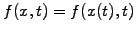
The chain rule can be used more formally to classify second order
equations (1.2.2#eq.1) with D=0 using an ansatz
along which discontinuities and the initial conditions propagate:
think of the path a heat pulse takes in an inhomogeneous material.
The chain rule can be used more formally to classify second order
equations (1.2.2#eq.1) with D=0 using an ansatz
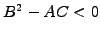 the equation has no characteristic and
is called elliptic (Laplace eq.)
the equation has no characteristic and
is called elliptic (Laplace eq.)
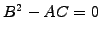 the equation has one characteristic and
is called parabolic (heat eq.)
the equation has one characteristic and
is called parabolic (heat eq.)
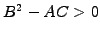 the equation has two characteristics and
is called hyperbolic (wave eq.)
the equation has two characteristics and
is called hyperbolic (wave eq.)
The local properties of a linear equation are conveniently investigated
by introducing the harmonic ansatz
 ,
which transforms differential operators in
,
which transforms differential operators in  into algebraic
expression in
into algebraic
expression in
 . In effect, you substitute
 and
and

 or
the growth rate
or
the growth rate
 to the typical scale of the solution
  .
Assuming a homogeneous grid in space
.
Assuming a homogeneous grid in space
 and time
 , it is moreover possible to assess the quality of the
numerical approximation, by relating the effective NUMERICAL phase
velocity or growth rate (i.e. obtained after discretization) to the
the spatial
, it is moreover possible to assess the quality of the
numerical approximation, by relating the effective NUMERICAL phase
velocity or growth rate (i.e. obtained after discretization) to the
the spatial  or temporal resolutions
 .
.
For example, take the effective wavenumber
 that results when the mid-point rule (1.2.1#eq.3) is used to
approximate the first derivative of the spatial function
that results when the mid-point rule (1.2.1#eq.3) is used to
approximate the first derivative of the spatial function
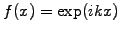 :
:
 and even changes sign with less than
two mesh points per wavelength. The forward difference (1.2.1#eq.2)
will be strongly damped
and even changes sign with less than
two mesh points per wavelength. The forward difference (1.2.1#eq.2)
will be strongly damped
![$ f\propto \exp[-\Im m(k_\mathrm{eff})\Delta x]$](s1img67.gif) .
.
SYLLABUS Previous: 1.2.3 Boundary / initial conditions Up: 1.2 Differential Equations Next: 1.2.5 Moments and conservation



![$\displaystyle k_\mathrm{eff}=-i\frac{\exp(ik\Delta x) -1}{\Delta x} = k \frac{\...
...s\left(\frac{k\Delta x}{2}\right) +i\sin\left(\frac{k\Delta x}{2}\right)\right]$](s1img66.gif)