

 Previous: Global effects
Up: UNDERLYING PHYSICS
Next: Local and global stability
Previous: Global effects
Up: UNDERLYING PHYSICS
Next: Local and global stability
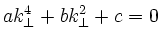 ,
where a
fast (long fluid scalelength) wave coalesces with a slow (short kinetic
scalelength) wave
,
where a
fast (long fluid scalelength) wave coalesces with a slow (short kinetic
scalelength) wave
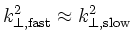 in the neighborhood of the resonance.
The efficiency of the power transfer depends on the wavefield amplitude
and the spatial extension over which the characteristic length and phase
of both waves match; a correct evaluation therefore requires solving a 4th
order equation, which, for the kinetic-Alfvén wave, amounts to keeping
the FLR correction term of
in the neighborhood of the resonance.
The efficiency of the power transfer depends on the wavefield amplitude
and the spatial extension over which the characteristic length and phase
of both waves match; a correct evaluation therefore requires solving a 4th
order equation, which, for the kinetic-Alfvén wave, amounts to keeping
the FLR correction term of
 in
(eq.1).
in
(eq.1).
Several ``ad-hoc'' models have been proposed to approximate this
conversion from the 2nd order (shear Alfvén) fluid MHD equation of
the form
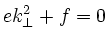 ,
which becomes singular as
,
which becomes singular as
 at the resonance.
Continuum damping [18,19] calculates the
residual absorption of the singularity directly from the MHD model
in the limit of an infinitesimal dissipation.
The trick describes the correct amount of mode converted power in an
unbounded domain [20], but we recently showed in Ref.[21]
that it dramatically fails when global effects alter the amplitude and
the phase of the fluid wavefield.
Complex resistivity resolves the singularity of the MHD equations
by adding an ad-hoc 4th order term, without consistently keeping the
corrections characteristic of the
kinetic-Alfvén wave. The mode conversion efficiency calculated in
this manner has never been validated even in 1D against a gyrokinetic
calculation, but the inconsistent treatment of the dispersion in the
neighborhood of fluid resonances is likely to suffer from the same
short commings as the continuum damping.
at the resonance.
Continuum damping [18,19] calculates the
residual absorption of the singularity directly from the MHD model
in the limit of an infinitesimal dissipation.
The trick describes the correct amount of mode converted power in an
unbounded domain [20], but we recently showed in Ref.[21]
that it dramatically fails when global effects alter the amplitude and
the phase of the fluid wavefield.
Complex resistivity resolves the singularity of the MHD equations
by adding an ad-hoc 4th order term, without consistently keeping the
corrections characteristic of the
kinetic-Alfvén wave. The mode conversion efficiency calculated in
this manner has never been validated even in 1D against a gyrokinetic
calculation, but the inconsistent treatment of the dispersion in the
neighborhood of fluid resonances is likely to suffer from the same
short commings as the continuum damping.
It is finally important to note that mode conversion is not only possible in the neighborhood of fluid resonances and neither does it take place exclusively to the kinetic Alfvén wave: mode conversion can in principle occur anywhere in the plasma where the spatial scale of a fast (fluid, MHD) wave and a slow (drift, surface quasi-electrostatic, kinetic Alfvén, energetic particle) wave match.
Previous: Global effects
Up: UNDERLYING PHYSICS
Next: Local and global stability
© André JAUN, Alfvén Laboratory, Royal Institute of Technology, Stockholm
![\includegraphics[height=6cm]{FIG/ResAbs.eps}](img29.gif)